





Read more

One Logo, One Name – Even More Possibilities

PCSS has become our only official brand for the whole world. In order to enhance communication and global identification of our Center, we decided to cease using PSNC (Poznan Supercomputing and Networking Center) and stay with the acronym of the original Polish name “Poznańskie Centrum Superkomputerowo-Sieciowe”.

Read more

PIAST-Q: A Leap for European Quantum Computing

PIAST-Q in Poznań, Poland is the first inauguration of a EuroHPC quantum computer marks a milestone in building a European quantum computing infrastructure. This is also the first EuroHPC infrastructure located in Poland.

Read more

First Polish AI Factory Consortium: PIAST-AI

Significant step towards making Europe a leader in AI technology has been taken – the PIAST-AI Factory at PCSS was selected by the European Commission to participate in the “AI Factories” program. This makes the Capital of Wielkopolska region a crucial driving force in the development of fields such as: IT, cybersecurity, space technologies, robotics, and sustainable development.

ICT Research and Development Center

PSNC provides access to a world-class e-Infrastructure for the scientific community, a specific research and development environment – DIGITAL SCIENCE – for “proof of concept” projects, prototyping or large-scale pilot projects. Another branch of our activity is in DIGITAL INDUSTRY, which is focused on the creation of innovations based on Information and Communication Technologies (ICT), i.e. the execution of specific implementations for various fields of science and industry. Equally important is our work in the context of SOCIAL INNOVATION to spread knowledge and awareness of contemporary technological opportunities among various social groups, as well as actively fighting against digital exclusion.
For over 30 years, we have been open to extensive cooperation both with research institutions to explore new areas of scientific challenges in joint projects and with industry partners – new entrants or large companies for which our competence and experience can become a strong asset to develop competitive innovation. Come and join us!

PCSS in numbers

employees

laboratories

years of operation

fields of activity

current projects

projects in Horizon Europe, Digital Europe Programme
  • Promotional banner for PRACE FENIX 2025 Call for Proposals, featuring the FENIX and PRACE logos alongside partners NECTEC, Jülich Supercomputing Centre, and PCSS on a geometric blue-orange background.

    PCSS supports the PRACE FENIX 2025 call for proposals.

    As part of the ongoing PRACE FENIX 2025 call for proposals, the offer of available infrastructure has been expanded to include additional cloud resources provided by PCSS. This initiative aims to support European research projects requiring advanced computing services and to provide free access to modern IT technologies for the scientific sector.

  • Group photo of eight men in business attire standing in front of a blue backdrop featuring the PCSS logo and the PIONIER network emblem, likely executives or leaders from PCSS, PIONIER, and partners discussing AI Gigafactory initiatives in Poznań.

    Poznań is ready for the AI Gigafactory – PCSS as a pillar of technological breakthrough.

    Poznań is emerging as one of the pillars of artificial intelligence in Central and Eastern Europe, and the Poznańskie Centrum Superkomputerowo-Sieciowe (PCSS) plays a key role in this process. As the operator of the PIONIER network and the national leader in research infrastructure, PCSS is laying the foundation for the development of large-scale AI systems, combining unique expertise with the highest data security standards.

  • Group photo of the Artificial Intelligence Council inauguration at the Greater Poland Voivodeship Marshal's Office (UMWW) in Poznań. PCSS logo in the top left corner; three PCSS representatives (Director Robert Pękal, Tomasz Parkoła, and Mikołaj Buchwald) stand among officials in suits against a blue backdrop with UMWW logos; held in a modern room with orange chairs.

    Inauguration of the UMWW Council for Artificial Intelligence

    In the headquarters of the Marshal's Office of the Greater Poland Voivodeship in Poznań, the activities of the Council for Artificial Intelligence were inaugurated. As an advisory body, it will support the processes of building a modern economy and administration based on AI foundations. The main goal of the established body is to develop innovative technological solutions, with particular emphasis on their practical application in the areas of healthcare, ecology, and public services provided to the region's residents.

  • A laptop displays the 3D-4CH Online Competence Centre website, showcasing a grid of news articles related to digital cultural heritage. The screen features a sidebar menu with sections like "Online Courses," "Tools," and "Knowledge Base." The laptop is set against a warm, minimalist interior with soft shadows and textured vertical wall panels.

    3D-4CH Launches Its 3D Online Competence Centre

    The 3D-4CH Online Competence Centre in 3D is officially live — offering cultural heritage professionals a first look at a collaborative digital ecosystem designed to make 3D cultural heritage data more accessible, enriched, and reusable across Europe. Co-funded by the European Union, the platform combines advanced digital tools, training opportunities, and curated knowledge to support a broad range of heritage use cases from research to education and tourism.

  • A person stands at a podium giving a presentation in a lecture room at Forschungszentrum Jülich, with a projection screen on the left showing a map and server racks, and PCSS and Jülich logos visible in the scene.

    Inauguration of the QEC4QEA Project in Jülich

    On January 19–21, 2026, the inauguration of the QEC4QEA project (Quantum Centre of Excellence for Quantum Enhanced Applications) took place at the Jülich Supercomputing Centre (JSC) in Germany. The initiative brings together 19 institutions from across Europe. The project partners will collaborate on developing solutions that enable the creation of unified access platforms for quantum computers distributed across various European sites.

  • A blue and beige promotional graphic for the “Genomics for Poland (G4PL)” project showing a large DNA double helix over Polish city landmarks, the PCSS logo, and logos of the European Funds for a Modern Economy, the Republic of Poland, and the European Union.

    Poland’s largest genomics project is underway: “Genomika dla Polski” (G4PL) opens a new chapter in population genetics research.

    In January 2026, the largest genomics project in Poland will launch, opening a new chapter in the field of population genetics research. The project “Genomika dla Polski” (G4PL) is funded by the European Union under the FENG programme (European Funds for a Modern Economy), Action 2.4 – Research Infrastructure of the Modern Economy. The project brings together 12 research and academic institutions from across the country, with the Institute of Bioorganic Chemistry of the Polish Academy of Sciences (ICHB PAS) acting as the consortium leader.

  • Promotional graphic with the PCSS logo on the left and the Enea Operator logo on the right, featuring the title “RankINN dla Enea Operator” overlaid on a background showing a person using a tablet, server racks, and colorful data charts and graphs symbolizing energy and digital infrastructure analytics.

    PCSS introduces RankINN app for Enea Operator

    PCSS has developed and implemented the complete RankINN software solution, which supports decision-making processes in the area of energy investments. The solution, based on a proprietary investment algorithm, was created in close substantive cooperation with experts from Enea Operator and constitutes a key element in the digitalisation of energy infrastructure.

  • The image features a silver desktop monitor positioned at an angle against a dark gray background, showcasing a website titled "Master 3D Techniques for Cultural Heritage." The website on the screen displays a sleek interface with a large image of an ancient vase and various navigation menus. In the top left corner, there is a white "PCSS" logo, while the bottom left features an orange decorative graphic resembling a circuit board or nodes. The overall composition is clean and professional, using a minimalist aesthetic to highlight the digital content on the screen.

    Stay Connected: Subscribe to the 3D-4CH Newsletter

    The 3D-4CH project – which PCSS is a proud partner of – focuses on developing an Online Competence Center that will provide access to knowledge, tools and training for the 3D digitisation and preservation of cultural heritage. By subscribing to the 3D-4CH Newsletter, you will be among the first to find out about the launch of the Online Competence Center, with early insights into its content and upcoming offerings.

  • Four men in formal attire standing side by side during a meeting, posing in front of a projection screen in an interior hall; the PCSS logo is visible in the upper-left corner, with a decorative graphic line in the lower-left.

    New Leadership of the Konsorcjum PIONIER Council – Artur Binczewski Appointed Chair for the 2026–2028 Term

    On 18 February this year, a reporting and election meeting of the Council of the Konsorcjum PIONIER was held at the Pałac Staszica. The most important item on the agenda was the conclusion of the long-standing mission of Dr. Eng. Maciej Stroiński, who had served as Chair of the PIONIER Consortium Council. Artur Binczewski, Head of the Network Technologies Division at Poznańskie Centrum Superkomputerowo-Sieciowe (PCSS), was elected as the new Chair of the Council.

  • Temple of Debod in Madrid at dusk, illuminated with warm light and reflected in a calm water surface; on the right, the text “Data Spaces Symposium” with a network-style data graphic, and the PCSS logo in the upper-left corner.

    Madrid as the Data Capital: A Summary of Data Spaces Symposium 2026

    The fourth edition of the most important event dedicated to European data spaces has come to a close. Following successful gatherings in The Hague, Frankfurt, and Warsaw, this time digital sector leaders met in Madrid. This year’s theme—“Accelerating adoption. Increasing impact”—set the direction for discussions on the future of the global data-driven economy.

  • A large group photo of approximately 40 diverse professionals, including men and women of various ages, posing together on a grand curved stone staircase in an elegant European interior with ornate railings and light stone walls. They are dressed in business casual attire such as shirts, sweaters, jackets, and scarves, suggesting a formal event. In the background stands a prominent vertical banner reading "3D-4CH" with a rainbow-colored logo and text "Online Competence Center for 3D in Cultural Heritage," confirming this as the first 3D-4CH Winter School held January 21-23, 2026, at the Art & History Museum in Brussels, organized by the EU-funded 3D-4CH project with PCSS involvement.

    3D-4CH Winter School 2026: From strategy to practice

    The first edition of the 3D-4CH Winter School took place on 21–23 January 2026 at the Art & History Museum in Brussels. The event inaugurated the seasonal schools programme of the Online Competence Centre 3D-4CH – an EU-funded initiative supporting skills development, interoperability, and innovation in the field of 3D cultural heritage. Over 100 participants from across Europe, including representatives of PCSS, gathered to explore the impact of 3D digitisation, extended reality (XR), and digital storytelling on heritage practices.

  • Group photo of PCSS representatives and WODR staff at the Greater Poland Agricultural Advisory Center training event on AI and robotics in crop protection, standing in front of a green banner with wheat emblem, logo, and event details.

    WODR Training: Crop Protection in Modern Agriculture

    The application of proprietary irrigation algorithms and LoRaWAN infrastructure enabled potato yields to increase by more than a quarter while simultaneously saving water. The results of the PCSS team's work were presented during a training session organized by the Greater Poland Agricultural Advisory Center, dedicated to AI and robotics in crop protection.

  • Michał Zimkiewicz, SHOP4CF Architecture for Flexible Smart Manufacturing, Poznań Supercomputing and Networking Center (PCSS). Promotional graphic featuring PCSS logo, blue background, orange graphic lines, and a photo of a man in a suit.

    PCSS expert co‑author of a scientific publication in a prestigious journal on the modular reference architecture of SHOP4CF

    The article “The SHOP4CF modular reference architecture for flexible process-oriented, data-driven smart manufacturing” by Paul Grefen, Michał Zimniewicz (PCSS, Large-Scale Applications and Services Department), Irene Vanderfeesten, Kostas Tragonas, Pieter Becue, Anders Pedersen, and Genessis Perez Rivera has been published in issue 85 of the Journal of Manufacturing Systems, available on ScienceDirect.

  • The image is a promotional graphic for a project called "Lumen" and features a person named Aleksandra Nowak. A professional portrait of Aleksandra Nowak, a woman with glasses, is on the left side of the graphic. The top right of the graphic contains two smaller images: one of a glass globe resting on a bed of moss, and another of a foggy, mountainous landscape. Below the images is a section dedicated to "Lumen Voices | Spotlight on our partners" with the logo "PCSS" and the name "Aleksandra Nowak." The bottom of the graphic includes text indicating that the project is "Funded by the European Union" and a website address.

    PCSS’ Aleksandra Nowak Is One of LUMEN’s Voices

    An interview with Aleksandra Nowak – the Head of Digital Libraries and Knowledge Platforms Department of PCSS, has just appeared on the lumenproject.eu website as a part of the LUMEN Voices series. Aleksandra gave an insight on her team’s role in the LUMEN project, which combines mathematical sciences, humanities, social sciences, earth systems, molecular dynamics, and more.

  • About PSNC in GÉANT CONNECT

    About PSNC in GÉANT CONNECT

    The latest, June issue of the magazine "CONNECT", focused on the GÉANT network and community, features an article on next-generation research infrastructures. These projects are being implemented within four leading projects run by PCSS and based on the PIONIER Network.

  • GÉANT’s “Foresight 2030: Navigating Change” Report

    GÉANT’s “Foresight 2030: Navigating Change” Report

    At the end of 2024, GÉANT released a report identifying the key opportunities and challenges facing the NREN community (National Research and Education Network) in the coming decade. One of the authors of this document is Raimundas Tuminauskas – Head of the Network Infrastructure and Services Department at PSNC.

  • Nobel Prizes 2024: AI in Physics and Chemistry

    Nobel Prizes 2024: AI in Physics and Chemistry

    This year's Nobel Prizes in Physics and Chemistry highlight the groundbreaking role of artificial intelligence in those fields. To get insights into this significant development, we reached out to Dr Mikołaj Buchwald – an expert from the PSNC Internet Services Department, whose research interests include cognitive neuroscience, machine learning methodology, as well as using AI plus advanced data analysis to explain human physiology and psychology.

  • PSNC Leaps into the future of computing

    PSNC Leaps into the future of computing

    Thanks to the Dariah.lab infrastructure, the first pilot projects for the preservation and dissemination of cultural heritage resources have been implemented in 2023. Dariah.lab is a research infrastructure for the humanities and arts, built as part of the DARIAH-PL project. It serves to acquire, store and integrate cultural data from the humanities and social sciences, and to process, visualise and share digital resources.

  • International Media on PSNC

    International Media on PSNC

    Here is a short sellection of recent articles on PSNC that have appeared in some international media.

  • Promotional banner for PRACE FENIX 2025 Call for Proposals, featuring the FENIX and PRACE logos alongside partners NECTEC, Jülich Supercomputing Centre, and PCSS on a geometric blue-orange background.

    PCSS supports the PRACE FENIX 2025 call for proposals.

    As part of the ongoing PRACE FENIX 2025 call for proposals, the offer of available infrastructure has been expanded to include additional cloud resources provided by PCSS. This initiative aims to support European research projects requiring advanced computing services and to provide free access to modern IT technologies for the scientific sector.

  • Four men in formal attire standing side by side during a meeting, posing in front of a projection screen in an interior hall; the PCSS logo is visible in the upper-left corner, with a decorative graphic line in the lower-left.

    New Leadership of the Konsorcjum PIONIER Council – Artur Binczewski Appointed Chair for the 2026–2028 Term

    On 18 February this year, a reporting and election meeting of the Council of the Konsorcjum PIONIER was held at the Pałac Staszica. The most important item on the agenda was the conclusion of the long-standing mission of Dr. Eng. Maciej Stroiński, who had served as Chair of the PIONIER Consortium Council. Artur Binczewski, Head of the Network Technologies Division at Poznańskie Centrum Superkomputerowo-Sieciowe (PCSS), was elected as the new Chair of the Council.

  • Group photo of eight men in business attire standing in front of a blue backdrop featuring the PCSS logo and the PIONIER network emblem, likely executives or leaders from PCSS, PIONIER, and partners discussing AI Gigafactory initiatives in Poznań.

    Poznań is ready for the AI Gigafactory – PCSS as a pillar of technological breakthrough.

    Poznań is emerging as one of the pillars of artificial intelligence in Central and Eastern Europe, and the Poznańskie Centrum Superkomputerowo-Sieciowe (PCSS) plays a key role in this process. As the operator of the PIONIER network and the national leader in research infrastructure, PCSS is laying the foundation for the development of large-scale AI systems, combining unique expertise with the highest data security standards.

  • Temple of Debod in Madrid at dusk, illuminated with warm light and reflected in a calm water surface; on the right, the text “Data Spaces Symposium” with a network-style data graphic, and the PCSS logo in the upper-left corner.

    Madrid as the Data Capital: A Summary of Data Spaces Symposium 2026

    The fourth edition of the most important event dedicated to European data spaces has come to a close. Following successful gatherings in The Hague, Frankfurt, and Warsaw, this time digital sector leaders met in Madrid. This year’s theme—“Accelerating adoption. Increasing impact”—set the direction for discussions on the future of the global data-driven economy.

  • The image is a promotional graphic for a project called "Lumen" and features a person named Aleksandra Nowak. A professional portrait of Aleksandra Nowak, a woman with glasses, is on the left side of the graphic. The top right of the graphic contains two smaller images: one of a glass globe resting on a bed of moss, and another of a foggy, mountainous landscape. Below the images is a section dedicated to "Lumen Voices | Spotlight on our partners" with the logo "PCSS" and the name "Aleksandra Nowak." The bottom of the graphic includes text indicating that the project is "Funded by the European Union" and a website address.

    PCSS’ Aleksandra Nowak Is One of LUMEN’s Voices

    An interview with Aleksandra Nowak – the Head of Digital Libraries and Knowledge Platforms Department of PCSS, has just appeared on the lumenproject.eu website as a part of the LUMEN Voices series. Aleksandra gave an insight on her team’s role in the LUMEN project, which combines mathematical sciences, humanities, social sciences, earth systems, molecular dynamics, and more.

  • Group photo of the Artificial Intelligence Council inauguration at the Greater Poland Voivodeship Marshal's Office (UMWW) in Poznań. PCSS logo in the top left corner; three PCSS representatives (Director Robert Pękal, Tomasz Parkoła, and Mikołaj Buchwald) stand among officials in suits against a blue backdrop with UMWW logos; held in a modern room with orange chairs.

    Inauguration of the UMWW Council for Artificial Intelligence

    In the headquarters of the Marshal's Office of the Greater Poland Voivodeship in Poznań, the activities of the Council for Artificial Intelligence were inaugurated. As an advisory body, it will support the processes of building a modern economy and administration based on AI foundations. The main goal of the established body is to develop innovative technological solutions, with particular emphasis on their practical application in the areas of healthcare, ecology, and public services provided to the region's residents.

  • About PSNC in GÉANT CONNECT

    About PSNC in GÉANT CONNECT

    The latest, June issue of the magazine "CONNECT", focused on the GÉANT network and community, features an article on next-generation research infrastructures. These projects are being implemented within four leading projects run by PCSS and based on the PIONIER Network.

  • A laptop displays the 3D-4CH Online Competence Centre website, showcasing a grid of news articles related to digital cultural heritage. The screen features a sidebar menu with sections like "Online Courses," "Tools," and "Knowledge Base." The laptop is set against a warm, minimalist interior with soft shadows and textured vertical wall panels.

    3D-4CH Launches Its 3D Online Competence Centre

    The 3D-4CH Online Competence Centre in 3D is officially live — offering cultural heritage professionals a first look at a collaborative digital ecosystem designed to make 3D cultural heritage data more accessible, enriched, and reusable across Europe. Co-funded by the European Union, the platform combines advanced digital tools, training opportunities, and curated knowledge to support a broad range of heritage use cases from research to education and tourism.

  • A person stands at a podium giving a presentation in a lecture room at Forschungszentrum Jülich, with a projection screen on the left showing a map and server racks, and PCSS and Jülich logos visible in the scene.

    Inauguration of the QEC4QEA Project in Jülich

    On January 19–21, 2026, the inauguration of the QEC4QEA project (Quantum Centre of Excellence for Quantum Enhanced Applications) took place at the Jülich Supercomputing Centre (JSC) in Germany. The initiative brings together 19 institutions from across Europe. The project partners will collaborate on developing solutions that enable the creation of unified access platforms for quantum computers distributed across various European sites.

  • GÉANT’s “Foresight 2030: Navigating Change” Report

    GÉANT’s “Foresight 2030: Navigating Change” Report

    At the end of 2024, GÉANT released a report identifying the key opportunities and challenges facing the NREN community (National Research and Education Network) in the coming decade. One of the authors of this document is Raimundas Tuminauskas – Head of the Network Infrastructure and Services Department at PSNC.

  • A blue and beige promotional graphic for the “Genomics for Poland (G4PL)” project showing a large DNA double helix over Polish city landmarks, the PCSS logo, and logos of the European Funds for a Modern Economy, the Republic of Poland, and the European Union.

    Poland’s largest genomics project is underway: “Genomika dla Polski” (G4PL) opens a new chapter in population genetics research.

    In January 2026, the largest genomics project in Poland will launch, opening a new chapter in the field of population genetics research. The project “Genomika dla Polski” (G4PL) is funded by the European Union under the FENG programme (European Funds for a Modern Economy), Action 2.4 – Research Infrastructure of the Modern Economy. The project brings together 12 research and academic institutions from across the country, with the Institute of Bioorganic Chemistry of the Polish Academy of Sciences (ICHB PAS) acting as the consortium leader.

  • Nobel Prizes 2024: AI in Physics and Chemistry

    Nobel Prizes 2024: AI in Physics and Chemistry

    This year's Nobel Prizes in Physics and Chemistry highlight the groundbreaking role of artificial intelligence in those fields. To get insights into this significant development, we reached out to Dr Mikołaj Buchwald – an expert from the PSNC Internet Services Department, whose research interests include cognitive neuroscience, machine learning methodology, as well as using AI plus advanced data analysis to explain human physiology and psychology.

  • Promotional graphic with the PCSS logo on the left and the Enea Operator logo on the right, featuring the title “RankINN dla Enea Operator” overlaid on a background showing a person using a tablet, server racks, and colorful data charts and graphs symbolizing energy and digital infrastructure analytics.

    PCSS introduces RankINN app for Enea Operator

    PCSS has developed and implemented the complete RankINN software solution, which supports decision-making processes in the area of energy investments. The solution, based on a proprietary investment algorithm, was created in close substantive cooperation with experts from Enea Operator and constitutes a key element in the digitalisation of energy infrastructure.

  • A large group photo of approximately 40 diverse professionals, including men and women of various ages, posing together on a grand curved stone staircase in an elegant European interior with ornate railings and light stone walls. They are dressed in business casual attire such as shirts, sweaters, jackets, and scarves, suggesting a formal event. In the background stands a prominent vertical banner reading "3D-4CH" with a rainbow-colored logo and text "Online Competence Center for 3D in Cultural Heritage," confirming this as the first 3D-4CH Winter School held January 21-23, 2026, at the Art & History Museum in Brussels, organized by the EU-funded 3D-4CH project with PCSS involvement.

    3D-4CH Winter School 2026: From strategy to practice

    The first edition of the 3D-4CH Winter School took place on 21–23 January 2026 at the Art & History Museum in Brussels. The event inaugurated the seasonal schools programme of the Online Competence Centre 3D-4CH – an EU-funded initiative supporting skills development, interoperability, and innovation in the field of 3D cultural heritage. Over 100 participants from across Europe, including representatives of PCSS, gathered to explore the impact of 3D digitisation, extended reality (XR), and digital storytelling on heritage practices.

  • PSNC Leaps into the future of computing

    PSNC Leaps into the future of computing

    Thanks to the Dariah.lab infrastructure, the first pilot projects for the preservation and dissemination of cultural heritage resources have been implemented in 2023. Dariah.lab is a research infrastructure for the humanities and arts, built as part of the DARIAH-PL project. It serves to acquire, store and integrate cultural data from the humanities and social sciences, and to process, visualise and share digital resources.

  • The image features a silver desktop monitor positioned at an angle against a dark gray background, showcasing a website titled "Master 3D Techniques for Cultural Heritage." The website on the screen displays a sleek interface with a large image of an ancient vase and various navigation menus. In the top left corner, there is a white "PCSS" logo, while the bottom left features an orange decorative graphic resembling a circuit board or nodes. The overall composition is clean and professional, using a minimalist aesthetic to highlight the digital content on the screen.

    Stay Connected: Subscribe to the 3D-4CH Newsletter

    The 3D-4CH project – which PCSS is a proud partner of – focuses on developing an Online Competence Center that will provide access to knowledge, tools and training for the 3D digitisation and preservation of cultural heritage. By subscribing to the 3D-4CH Newsletter, you will be among the first to find out about the launch of the Online Competence Center, with early insights into its content and upcoming offerings.

  • Group photo of PCSS representatives and WODR staff at the Greater Poland Agricultural Advisory Center training event on AI and robotics in crop protection, standing in front of a green banner with wheat emblem, logo, and event details.

    WODR Training: Crop Protection in Modern Agriculture

    The application of proprietary irrigation algorithms and LoRaWAN infrastructure enabled potato yields to increase by more than a quarter while simultaneously saving water. The results of the PCSS team's work were presented during a training session organized by the Greater Poland Agricultural Advisory Center, dedicated to AI and robotics in crop protection.

  • International Media on PSNC

    International Media on PSNC

    Here is a short sellection of recent articles on PSNC that have appeared in some international media.

e-Infrastructure Center

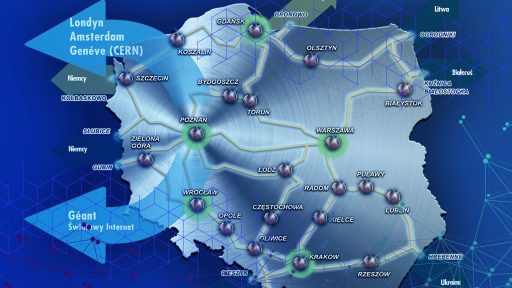
Our mission is “Integration and development of IT infrastructure of science”. We provide the scientific community with access to world-class IT infrastructure. As the operator of the national PIONIER network and the city’s POZMAN network, we provide fast and secure access to the Internet and network services at international, national and local level. As a Supercomputing Center, we offer a wide range of computing services, access to virtual servers, cloud services, while allowing for fast and scalable data management.
Quantum Technologies
Artificial Intelligence
Cybersecurity
Services and innovations
Laboratories
Digital Innovation Hubs
European Open Science Cloud (EOSC)
Polish Roadmap for Research Infrastructures
PIONIER Polish Optical Internet
High Performance Computing (HPC)
Data Management
Géant

Our membership in international organizations and associations

Our membership

GÉANT Logo
Partnership for Advanced Computing in Europe Logo
European Open Science Cloud Logo
INTERNET 2 Logo
European Cluster Collaboration Platform Logo
Open & Agile Smart Cities Logo
AI DIH network Logo
EUDAT Collaborative Data Infrastructure Logo
Big Data Value Association Logo
GAIA-X Logo
Alliance for Internet of Things Innovation Logo
European Network of Living Labs Logo
Next Generation Internet Logo
FIWARE Logo
OPEN GEOSPATIAL Logo
International Data Spaces Association Logo
IBM QUANTUM Logo
EPSI Logo
AI Factories Logo
Quantum Flagship Logo

PCSS activities are supported by

Ministerstwo Nauki i Szkolnictwa Wyższego Logo
Ministerstwo Cyfryzacji Logo
Ministerstwo Rozwoju i Technologii Logo
Ministerstwo Finansów Logo
EuroHPC Logo
European Commission Logo